Situational Judgment Test Practice
Master the decision-making scenarios that test your judgment. Practice with realistic work situations and learn what rail employers look for.
What Does the SJT Measure?
Decision Making
Choosing appropriate actions in work-related scenarios
Judgment
Evaluating situations and selecting the best course of action
Safety Awareness
Understanding and prioritizing safety in operational contexts
Professional Conduct
Demonstrating appropriate workplace behavior and communication
Types of Scenarios
Safety Scenarios
Responding to signals, track conditions, and emergency situations
Customer Service
Handling passenger interactions, complaints, and difficult situations
Team Dynamics
Working with colleagues, following instructions, and reporting issues
Conflict Resolution
Managing disagreements and maintaining professionalism under pressure
How the Test Works
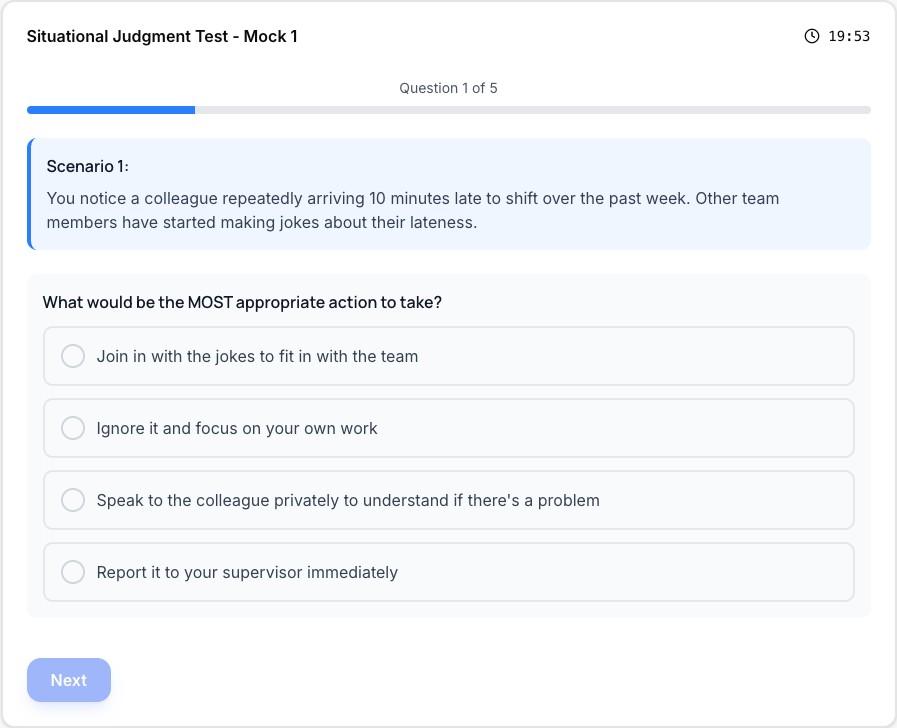
Read Scenario
A workplace situation is described in detail
Consider Options
Multiple possible responses are provided
Select Best
Choose the most appropriate response
Repeat
Answer multiple scenarios within the time limit
Expert Tips to Pass
Safety First
In rail, safety always comes first. When in doubt, choose the option that prioritizes safety.
Consider Others
Think about passengers, colleagues, and the company. Good decisions balance multiple stakeholders.
Follow Protocol
Train driving is rule-bound. Choose responses that follow established procedures over quick fixes.
Be Professional
Even in difficult situations, the best answer maintains professionalism and composure.
Frequently Asked Questions
The Situational Judgment Test presents work-related scenarios and asks you to choose the most and least appropriate responses. It assesses your judgment, decision-making, and approach to workplace situations.
Responses are compared to ideal answers determined by rail industry experts. Higher scores align with what experienced professionals would do in the same situation.
The SJT typically takes 20-30 minutes. You should read each scenario carefully and consider all options before answering.
Good answers prioritize safety, follow procedures, consider others, and maintain professionalism. Quick fixes that break protocol or compromise safety are usually incorrect.
After completing the test, you'll see detailed feedback showing your responses and the ideal answers. This helps you understand the reasoning behind correct responses and improve for future attempts.
Our SJT scenarios are original practice material that reflects the kinds of situations train drivers face, developed with input on railway decision-making to give you realistic preparation.
Want a deeper dive? Read our complete SJT guide →
Practice Your Judgment Today
Train drivers make critical decisions every day. Show rail employers you have the judgment and decision-making skills for the role.